
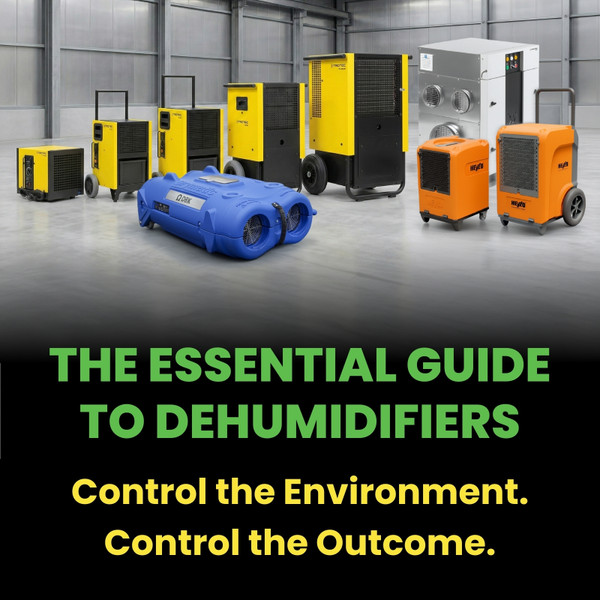
Choosing a Dehumidifier for Water Damage Restoration
Understanding Psychrometry, Equipment Selection, and Verifiable Outcomes
In Australian water damage restoration, dehumidifiers and atmospheric controllers are the primary tools used to achieve controlled, verifiable drying outcomes. When applied in accordance with the AS-IICRC S500:2025 Standard and the methodologies championed by the Australian Cleaning and Restoration Academy (ACRA), effective drying is not based on guesswork or timeframes, but on the deliberate management of vapour pressure to reach a documented Dry Standard.
At its core, professional drying is a psychrometric process. The restorer’s role is to manipulate temperature, humidity, and air movement to create sustained vapour pressure differentials that drive moisture out of materials and into the air — where it can be removed, measured, and verified.
The Three Pillars of Dehumidification Technology
Modern restoration relies on three distinct atmospheric control technologies. Each plays a specific role depending on ambient temperature, material porosity, and the Class of Water Loss.
Understanding where each technology performs best is essential to equipment selection and predictable drying outcomes.
1. Refrigerant (Condensation) Dehumidifiers
A Refrigerant dehumidifier for water damage remains the industry workhorse for the majority of residential and light commercial restoration projects.
These units draw moist air through the machine, pass it over a cold evaporator coil where vapour condenses into liquid, then reheat and discharge dry air back into the drying chamber.
Under appropriate temperature conditions, refrigerant dehumidifiers offer an efficient balance of moisture removal and energy use.
2. Desiccant (Adsorption) Dehumidifiers
A Desiccant dehumidifier for water damage uses a silica-gel rotor to chemically adsorb water vapour from the air.
Because this process does not rely on dew point or coil temperature, desiccants can achieve ultra-low humidity environments, often below 10 GPP, making them effective for dense materials and deep-seated moisture.
3. Heat Drying & Air Exchange (DBK Drymatic II)
The DBK Drymatic II increases vapour pressure within materials by heating the drying chamber, then removes moisture by exhausting humid air from the structure.
Its patented “Recirculation vs. Exhaust” logic allows technicians to adapt the drying strategy based on conditions and moisture load.
This technology is particularly effective for target drying, complex cavities, and concealed spaces.
Detailed Model Comparison: Advantages and Limitations
Selecting the correct unit requires balancing the Class of Water Loss (Class 1–4) against machine performance characteristics.
Compact & Residential Dehumidifiers
Trotec TTK Qube
- Advantages: Lightweight (16 kg), ideal for apartments and high-rise environments. Integrated 10 m condensate pump and low-noise Comfort Mode.
- Limitations: 20 L/day capacity limits use to small rooms (~110 m³) and Class 1 losses.
Heylo KT 20
- Advantages: Durable housing, 375 CMH airflow, supports ducting for targeted drying.
- Limitations: Performance declines near 35°C ambient temperatures.
Standard Commercial Dehumidifiers
Trotec TTK 175 / Heylo KT 45
- Advantages: Reliable mid-range units (~50 L/day), suitable for Class 2 residential floods.
- Limitations: Often require multiple units for Class 3 losses.
High-Capacity & Industrial Dehumidifiers
Trotec TTK 355 / TTK 500
- Advantages: High-pressure fans, effective in colder climates (TTK 500 hot gas bypass).
- Limitations: Heavy (39–52 kg) and higher power draw.
Trotec TTK 900 MP
- Advantages: Up to 110 L/day removal, VarioDry technology for restoration or construction modes.
- Limitations: Excessive for small jobs; 850 CMH airflow requires careful balancing.
Specialty Equipment
Trotec TTR 800 (Desiccant)
- Advantages: Suitable for Class 4 drying; operates in sub-zero temperatures.
- Limitations: High power consumption and complex ducting requirements.
DBK Drymatic II
- Advantages: Ideal for cavity and subfloor drying; strong vapour pressure creation.
- Limitations: Requires clear exhaust path for effective operation.
Equipment Selection Matrix
| Model | Technology | Best Suited For | Limitation |
|---|---|---|---|
| TTK Qube / KT 20 | Refrigerant | High-rise apartments | Limited capacity |
| TTK 175 / KT 45 | Refrigerant | Standard residential floods | Mid-range extraction |
| TTK 500 | Refrigerant | Cold climates | Heavy weight |
| TTK 900 MP | Refrigerant | Large commercial floods | High power draw |
| TTR 800 | Desiccant | Hardwood and concrete | Complex setup |
| Drymatic II | Heat Exchange | Target drying / cavities | Requires venting |
Professional Maintenance and Verification
To meet AS-IICRC S500:2025 audit requirements, restorers must document equipment performance daily.
- Grain Depression: Measure GPP entering versus exiting the unit. No grain depression indicates no moisture processing.
- Air Exchange (ACH): Confirm CMH rating supports room volume. Benchmark for Class 2 losses is 4 air exchanges per hour.
- Filter Integrity: Clean or replace filters after every Category 2 or 3 job.
Frequently Asked Questions
Does a dehumidifier help with water damage?
Yes — dehumidification is not optional in a compliant drying plan. Extraction and air movement alone cannot remove moisture that has already migrated into building materials as vapour. A dehumidifier lowers the vapour pressure of the surrounding air, creating the differential needed to draw that moisture out of hardwood, drywall, and structural framing. Without it, evaporated moisture simply recondenses elsewhere in the structure rather than being removed.
How long should you run a dehumidifier after water damage?
There is no fixed timeframe. Under AS-IICRC S500:2025, drying duration is determined by reaching a documented Dry Standard, not by the calendar. Equipment should run continuously until moisture readings in affected materials match an unaffected reference point, verified daily through grain depression and material moisture monitoring. Most Class 2 residential losses reach dry standard in 3–5 days with correctly sized equipment; Class 3 and 4 losses involving dense or saturated materials can take considerably longer.
How do you use a dehumidifier for water damage?
Start by sizing the unit to the Class of Water Loss and room volume, not just floor area. Position the dehumidifier to draw air from the wettest zone, seal the drying chamber where practical to maintain vapour pressure, and pair it with air movers set to create laminar airflow across affected surfaces. Monitor grain depression and air exchange daily — a benchmark of 4 air exchanges per hour (ACH) is typical for Class 2 losses — and adjust equipment placement or add units if targets aren't being met.
Final Thoughts
Dehumidifiers and heat drying systems are the engine room of structural drying. When selected correctly and paired with high-velocity air movement, they allow restorers to control the environment — not guess at it.
Understanding how and when to apply these technologies separates a professional restorer from a basic extractor and delivers consistent, verifiable drying outcomes.
Recent Posts
-

Protox WR20 Wins 2026 ISSA Excellence Award
Restore Solutions is proud to announce that Protox WR20 Antimicrobial Cleaner has been named a winne …13th Oct 2026 -
Hydroxyl Generator: How to Operate & Maintain Your Unit
A hydroxyl generator is a specialist piece of equipment used to assist with odour treatment and air …7th Oct 2026 -
Choosing Mould Removal Products: The Two S's of Speed and Safety in Remediation
When it comes to commercial mould remediation, cost is one of the biggest considerations for restora …16th Sep 2026