
Choosing Mould Removal Products: The Two S's of Speed and Safety in Remediation
When it comes to commercial mould remediation, cost is one of the biggest considerations for restoration businesses. There is an understandable temptation to look for the cheapest mould removal products or the lowest price per litre.
But does a product that costs less actually cost less to your business?
The purchase price of a chemical is only one part of the equation. A product that costs less per litre may require additional application time, agitation, wiping, rinsing, extraction or vacuuming. It may also require more technician time, additional equipment and, in some cases, further works if the desired result isn't achieved the first time.
Once labour and time are factored in, the "cheaper" product can quickly become the more expensive option.
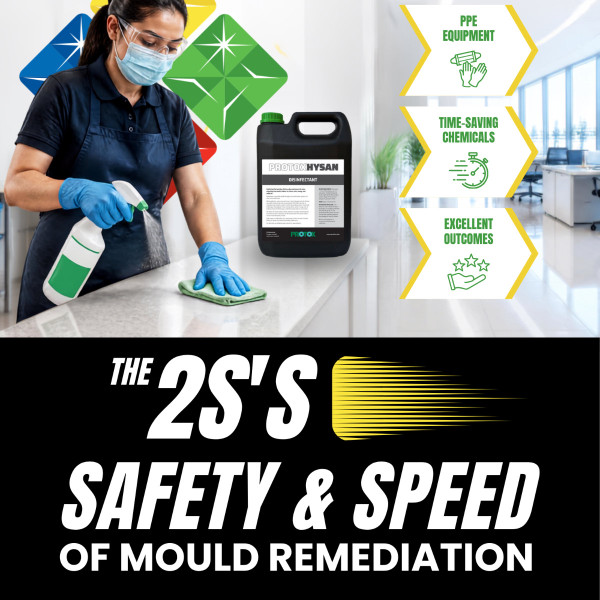
This is why the Two S's — Speed + Safety — should be at the centre of an efficient mould remediation process.
The objective isn't simply to find the cheapest mould removal products. It is to develop a process that achieves an effective result safely, efficiently and with as little unnecessary labour as possible.
What are the Two S's of mould remediation?
Speed and safety go hand in hand.
A fast remediation process is only valuable if it is completed safely and achieves the required result. Equally, a process that involves excessive cleaning, wiping and recovery may be effective but can quickly reduce productivity and increase the cost of the job.
The right combination of mould cleaning products, application equipment and mechanical agitation can help restorers streamline the process from initial cleaning through to final inspection.
So, what can that process look like?
1. Start with HEPA vacuuming
Once mould-affected materials have been removed where required and appropriate containment has been established, the remediation process can begin with thorough HEPA vacuuming.
The purpose is to remove settled mould spores, particles and other contamination from affected surfaces before wet cleaning begins.
Restore Solutions supplies HEPA vacuums from Husqvarna, which forms part of its professional restoration equipment range. HEPA filtration can be an important first step in reducing surface contamination and preparing the area for chemical treatment.
Starting with mechanical removal also means the chemical treatment can be focused on the remaining contamination rather than relying on the cleaning product to do everything.
2. Apply the right mould cleaning products
For suitable surfaces such as timber framing, the next stage is chemical cleaning.
Protox Hysan is a purpose-developed mould cleaner, remover and disinfectant available through Restore Solutions. The product uses chlorine dioxide chemistry and is designed to work as part of a spray, agitate and rinse cleaning process.
The product can be applied using equipment such as Gloria sprayers or Gloria foamers, while a Duo Mop can provide a controlled application method for suitable Condition 2 mould on plasterboard and other surfaces. Restore Solutions' mould remediation guide recommends different dilution ratios depending on the severity of the mould contamination, so technicians should always follow the current manufacturer's instructions and SDS.
Applying Hysan as a foam can also provide useful dwell time on vertical surfaces and timber framing before mechanical agitation.
3. Don't underestimate mechanical agitation
Chemical application is only one part of effective mould remediation.
The combination of chemical action and mechanical agitation is what physically helps remove mould from the surface.
Restore Solutions' Twin-Brush Cordless Power Scrubber Kit is designed specifically for this type of restoration work, with a telescopic handle extending from 134 cm to 180 cm. This allows technicians to mechanically agitate surfaces while reducing some of the physical effort associated with manual scrubbing.
For timber framing and other suitable surfaces, a powered brush can help technicians work through affected areas efficiently.
This is also where the true cost of a chemical becomes apparent.
A product might have a low purchase price, but if the process requires technicians to repeatedly apply, agitate, wipe, rinse and extract, the labour cost can quickly outweigh the saving made on the chemical.
The question shouldn't simply be "What does the chemical cost?"
It should be:
"What does it cost to complete the entire process?"
4. Rinse efficiently
Once the surface has been adequately agitated, it needs to be rinsed according to the product's instructions.
Restore Solutions' mould remediation process recommends using a pump-up sprayer — with Gloria Sprayers specifically recommended — or a microfibre Duo Mop for suitable plasterboard applications.
An efficient rinse process helps remove loosened mould, spores, particles and dirt from the surface. Rinsing is an important part of the remediation process, providing the physical removal of loosened mould, spores and residue from the treated area. When using the stabilised chlorine dioxide solution, Protox Hysan, the rinse helps physically remove the contamination following chemical treatment and mechanical agitation.
This is another area where selecting the right mould remediation equipment can save time. The objective is to clean the surface effectively without creating unnecessary additional recovery work.
Excess water can be managed appropriately, with technicians following the requirements of the surface, work environment and remediation plan.
5. Inspect before treating staining
Mould removal and mould staining are not necessarily the same problem.
After the initial cleaning process, allow the treated surface to undergo the appropriate oxidation period before assessing whether any visible staining remains.
If mould has been removed but a visual stain persists, a separate stain-removal treatment may be appropriate.
Restore Solutions stocks Protox HP18 Mould Stain Remover, a hydrogen peroxide-based product designed for mould staining and disinfection of suitable porous surfaces. Protox Turbo can be combined with HP18 to increase its stain-removal capability, according to the manufacturer's instructions.
The important principle is to treat staining as a separate finishing step rather than automatically using a stronger chemical throughout the entire cleaning process.
This targeted approach can help avoid unnecessary chemical use and labour.
6. Address areas that cannot be physically cleaned
Not every surface or cavity will be easily accessible.
Where physical cleaning isn't possible because of access limitations or the underlying material, Protox Encapsulator can provide another option within the remediation system as a professional water-based sealant designed for areas where mould cannot be physically cleaned because of difficult access or other conditions.
For surfaces where there is an ongoing risk of mould growth, Protox Protect Mould Preventative Sealer can be particularly valuable where the underlying moisture issue cannot be immediately resolved. For example, a bathroom ceiling may experience recurring moisture build-up because of inadequate ventilation. Once the existing mould has been properly treated and the surface cleaned, Mould Protect can be applied to provide ongoing protection against mould growth in an area that remains exposed to elevated moisture.
Where residual mould staining remains on timber, Protox HP18 with Turbo can be used as a targeted stain-removal treatment following the initial mould cleaning process. The combination is particularly useful for timber surfaces where mould staining can remain even after the contamination has been removed.
Of course, no preventative coating should be considered a substitute for identifying and addressing the underlying moisture source.
7. Adapt the process to the surface
One commercial mould remediation process does not necessarily suit every surface.
For example, Condition 2 surface mould on plasterboard requires a more controlled approach than heavily contaminated timber framing. Excessive spraying can introduce unnecessary moisture or create runs on vertical surfaces.
For these applications, a process such as:
Apply → agitate → mop/wipe
can provide greater control.
The Restore Solutions mould remediation guide specifically identifies the Duo Mop with microfibre as an application and rinsing option for suitable Condition 2 mould on plasterboard.
Microfibre cloths and suitable pads can then be used for detailed areas that larger cleaning equipment cannot reach.
The principle is simple: use the right product and the right equipment for the surface, rather than applying the same process everywhere.
Safety comes first
Speed should never mean cutting corners on safety.
Mould remediation can expose technicians to mould spores and contaminated materials, so appropriate PPE and work practices are essential. PPE requirements should be determined by the contamination; work being undertaken and applicable workplace requirements.
Restore Solutions' own mould remediation guide recommends appropriate respiratory and personal protective equipment, including a full-face respirator, protective suit and gloves for the process described.
Technicians should always follow the current product label, Safety Data Sheet (SDS), manufacturer's instructions and applicable Australian WHS requirements.
The aim is to create a process that is both efficient and controlled, rather than prioritising speed at the expense of technician safety.
Build a complete mould remediation system
The biggest opportunity for restoration businesses is to stop looking at mould remediation as simply the purchase of a chemical.
It is a system.
That system can include:
- HEPA vacuuming
- Appropriate containment
- PPE
- Mould cleaning products
- Chemical application equipment
- Mechanical agitation
- Controlled rinsing
- Microfibre cleaning systems
- Stain removal
- Encapsulation
- Preventative protection
- Appropriate inspection and verification
Restore Solutions brings many of these components together through its range of professional mould remediation equipment and chemical packages.
The Protox Mould Remediation Package, for example, provides a selection of mold cleaning chemicals, while Restore Solutions also offers dedicated Small, Medium and Large Mould Remediation Packages designed around different job requirements.
The real cost is the cost of the job
When comparing mould removal products, the price on the bottle doesn't tell the whole story.
Consider the complete job:
Product cost + application time + labour + agitation + wiping + rinsing + extraction + equipment + potential rework = true remediation cost.
A product that is cheaper per litre may not be cheaper once all of those factors are considered.
Conversely, investing in professional-grade mould cleaning products, suitable application equipment and mechanical cleaning tools can help reduce unnecessary labour and make the remediation process more efficient.
That's the value of the Two S's: Speed + Safety.
Restore Solutions provides a complete range of mould removal products and professional restoration equipment, from Protox Hysan and Protox HP18 through to Protox Protect and Encapsulator, Gloria application equipment, HEPA vacuums and powered scrubbers.
For restorers, the goal isn't simply to remove mould.
It's to develop a remediation process that is safe, repeatable, efficient and commercially viable — delivering a professional result while making every technician hour count.
Work smarter. Work safer. Remediate efficiently.
Recent Posts
-

Protox WR20 Wins 2026 ISSA Excellence Award
Restore Solutions is proud to announce that Protox WR20 Antimicrobial Cleaner has been named a winne …13th Oct 2026 -

Hydroxyl Generator: How to Operate & Maintain Your Unit
A hydroxyl generator is a specialist piece of equipment used to assist with odour treatment and air …7th Oct 2026 -
Choosing Mould Removal Products: The Two S's of Speed and Safety in Remediation
When it comes to commercial mould remediation, cost is one of the biggest considerations for restora …16th Sep 2026